I Shoulda Learned to Play the Guitar: Songs From When MTV Taught Us to See the Music
August 1, 2026, marks 45 years since MTV first went on the air. Yet there’s more than a little irony in marking that anniversary just seven months after several of MTV’s remaining music-only channels went dark. It feels less like a birthday and more like a bookend.
MTV Music chose “Video Killed the Radio Star” as its last video — the same video that had launched MTV in 1981. You could hardly have scripted a more fitting ending.
The flagship MTV channel still exists in the United States, but the MTV I remember — the one built around music videos, familiar VJs, and the anticipation of not knowing what would play next — has been gone for a long time.
I remember when MTV was the incredibly cool channel we couldn’t even get at our house. No, my first memories of MTV aren’t of watching it at home. It was part of a pay cable service, and my family didn’t subscribe. If I wanted my MTV — and we all did back then — I had to go somewhere else.
Fortunately, one of my friends had it. That friend’s family had a back room … maybe a converted garage … I really don’t recall exactly, but I do remember it as a place where my friends hung out. And a place that became our unofficial music video headquarters.
The details of the room have faded, but I remember what it felt like to gather with friends and wait to see what MTV would play next. We couldn’t search for a particular video. We couldn’t skip one, replay one, or pull up a favorite whenever we wanted. I mean, in those days, you had to get up and go to the TV just to change the channel!
So we watched whatever came on.
But that was part of the magic. When a video we loved finally appeared, everyone in the room paid attention.
And while we waited, there were the VJs. Even that name sounded like something from the future. “VJ,” short for “video jockey,” was the television counterpart to radio’s DJ. MTV didn’t quite invent the term … it had circulated in New York clubs before the channel launched. But MTV made it part of our vocabulary.
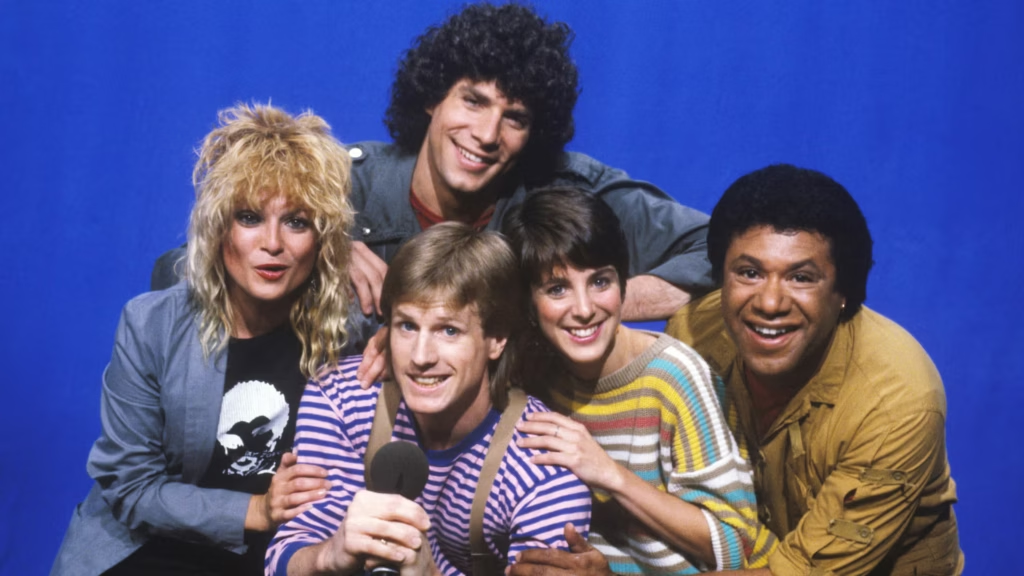
Nina Blackwood, Mark Goodman, Alan Hunter, J.J. Jackson, and Martha Quinn were the original five. They introduced the videos, interviewed the artists, and told us what was happening in music. More importantly, they gave MTV a personality. They weren’t some distant television announcers. Viewers knew their voices, their clothes, and their individual styles. People had their favorites. The VJs became celebrities in their own right because they seemed to have the best possible job: listening to music, meeting rock stars, and telling the rest of us what we needed to hear next.
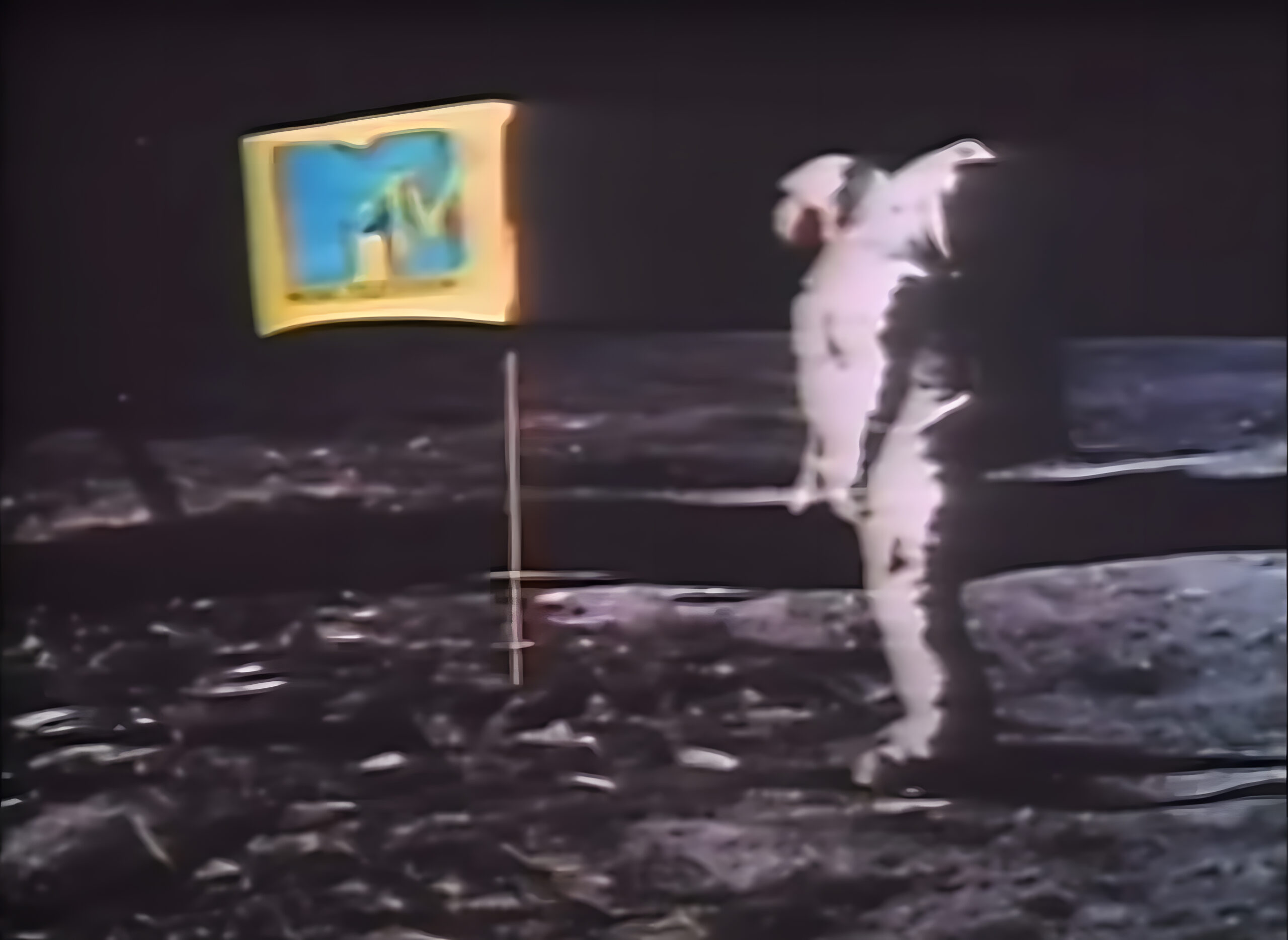
MTV introduced itself with that same sense of possibility. At 12:01 a.m. on August 1, 1981, viewers saw a rocket launch, an astronaut planting an MTV flag on the moon, and a rapidly changing logo accompanied by a voiceover saying, “Ladies and gentlemen, rock and roll.”
It was audacious, playfully irreverent, and almost impossibly ambitious. MTV wasn’t simply launching a television channel. It was planting its flag in popular culture.
Then came the Buggles and “Video Killed the Radio Star.”
Looking back, the song choice seems almost suspiciously perfect … prescient, even. MTV was about to create a new relationship between the music we heard and the images we saw.
Music no longer came to us only through speakers. A song could arrive with a leather jacket, a dance routine, a miniature movie, or an image so unforgettable that we would never hear the music without seeing it again. It became difficult to hear “Take On Me” without seeing those pencil-drawn panels, “Thriller” without picturing a red jacket and a line of dancing zombies, or “Nothing Compares 2 U” without seeing Sinéad O’Connor’s face and that single tear.
Some videos made songs into hits. Others transformed already successful songs into cultural landmarks. They helped create stars, revive careers, introduce fashions, cross musical boundaries, and occasionally start arguments that reached far beyond music.
MTV didn’t simply reflect the zeitgeist. It helped create it.
That history is too large for one playlist, so we’re telling it in two parts. This first part harkens back to MTV’s video-first era, beginning with the channel’s launch in 1981 and ending in 1991, when Nirvana’s “Smells Like Teen Spirit” helped announce a dramatic change in popular music.
Our next post will pick up after that, in 1992, the year The Real World premiered. That series didn’t suddenly bring MTV’s music-video era to an end, but it marked the beginning of a different kind of channel … one increasingly shaped by reality shows, original programming, and youth-culture personalities.
The line between those eras isn’t perfectly tidy; cultural transitions rarely are. But together, the two collections trace the story of how MTV changed the way we experienced music … and then what happened when music videos began to outgrow MTV.
The videos in this first collection appear chronologically … yes, rather unusual for a Songbird soundtrack. But this time, the sequence is part of the story. These aren’t necessarily the era’s biggest hits. But they’re videos that gave us something unforgettable to see, changed an artist’s career, or demonstrated just how much cultural power MTV once possessed.
So turn up the volume, watch the screens and, for just a little while, let’s go back to the days when all we really wanted was our MTV.
“Video Killed the Radio Star” — The Buggles
Of course, it had to begin here. The song was released in 1979, but when MTV selected it as the first video it aired on August 1, 1981, it became a prophecy … and the same video returned to close MTV Music on December 31, 2025.
“You Better Run” — Pat Benatar
MTV’s second video gave Pat Benatar an important place in television history: she was the first female artist to appear on the new channel.
The video itself is relatively simple, but Benatar’s striped shirt, leather pants and cropped hair helped establish the visual identity of a rising rock star — and she still has that famous shirt framed at home.
“Hungry Like the Wolf” — Duran Duran
Filmed in Sri Lanka by director Russell Mulcahy, “Hungry Like the Wolf” looked more like a swashbuckling adventure film than a conventional performance clip.
MTV’s heavy rotation helped turn Duran Duran into American stars, sent the song to No. 3 on the Billboard Hot 100 and helped the video become the first winner of the Grammy category now known as Best Music Video.
“Thriller” — Michael Jackson
At nearly 14 minutes, “Thriller” was less a promotional clip than a full-scale movie premiere, complete with director John Landis, Vincent Price’s unmistakable voice, and Michael Peters’ now-legendary zombie choreography.
MTV treated its showings like special events, and in 2009, “Thriller” became the first music video selected for preservation in the National Film Registry.
“Take On Me” — a-ha
“Take On Me” had already struggled in an earlier release before director Steve Barron placed a romance inside a pencil-drawn comic book.
Its combination of live action and painstaking rotoscope animation helped send the song to No. 1 in the United States and earned the video six awards at the 1986 MTV Video Music Awards.
“Money for Nothing” — Dire Straits
There is something wonderfully self-aware about a song criticizing rock stars and MTV while Sting sings the network’s most famous slogan in the background.
The blocky computer animation looked positively futuristic in 1985, and the video won Video of the Year at the 1986 MTV Video Music Awards and making one of its most memorable lyrics the perfect inspiration for this post’s title.
“Sledgehammer” — Peter Gabriel
Peter Gabriel reportedly spent hours lying beneath a sheet of glass while animators built this surreal procession around his face one frame at a time.
With contributions from Aardman Animations and the Brothers Quay, “Sledgehammer” combined stop motion, clay animation and pixilation — and collected a record nine awards at the 1987 MTV Video Music Awards.
“Walk This Way” — Run-D.M.C. featuring Aerosmith
The wall separating Run-D.M.C. from Aerosmith was not a particularly subtle metaphor, but it was exactly the right one.
When Steven Tyler smashed through it, the video helped bring hip-hop further into the mainstream, introduced Run-D.M.C. to MTV’s rock audience and gave Aerosmith’s career a much-needed second act.
“Land of Confusion” — Genesis
With its grotesque Spitting Image puppets portraying Ronald Reagan, Margaret Thatcher, celebrities, and the members of Genesis themselves, “Land of Confusion” turned Cold War anxiety into a dark political comedy.
The video won the 1988 Grammy for Best Concept Music Video, but lost the previous year’s VMA for Video of the Year to “Sledgehammer” — created by none other than Peter Gabriel, the band’s former lead singer.
“Like a Prayer” — Madonna
By 1989, Madonna understood that a music video could provoke a conversation far beyond the song itself. Its story of a Black man wrongfully accused of a crime appeared alongside burning crosses, stigmata and an interracial kiss.
Pepsi responded to the controversy by canceling its Madonna campaign, although she reportedly retained her $5 million fee.
“Rhythm Nation” — Janet Jackson
The black-and-white industrial setting, matching military-inspired uniforms and fiercely precise choreography made “Rhythm Nation” look like a movement viewers might actually join.
The song was part of Jackson’s ambitious 30-minute Rhythm Nation 1814 film, which earned her first Grammy Award and accompanied an album that produced a record-setting seven Top 5 hits.
“Nothing Compares 2 U” — Sinéad O’Connor
After the elaborate sets and special effects of the videos before it, “Nothing Compares 2 U” needed little more than Sinéad O’Connor’s face.
The tears were real — O’Connor later said she was thinking about her late mother — and the video made her the first female artist to win the MTV Video Music Award for Video of the Year.
“Smells Like Teen Spirit” — Nirvana
Samuel Bayer’s decaying high-school pep rally — with its anarchist cheerleaders, restless students and slowly mounting chaos — gave grunge its defining visual language.
MTV’s heavy rotation helped propel Nirvana and alternative rock into the mainstream; decades later, the video surpassed two billion views on YouTube, neatly pointing us toward the next chapter of the music-video story.
We began with an exploding radio and ended with a high-school gym coming apart. Between them, MTV changed the sound, style and visual language of popular music and taught a generation to hear songs with its eyes.
But another revolution was approaching. In our next post, we’ll begin with the 1992 arrival of The Real World and follow the music video as it gradually moves beyond MTV and into an entirely new reality.
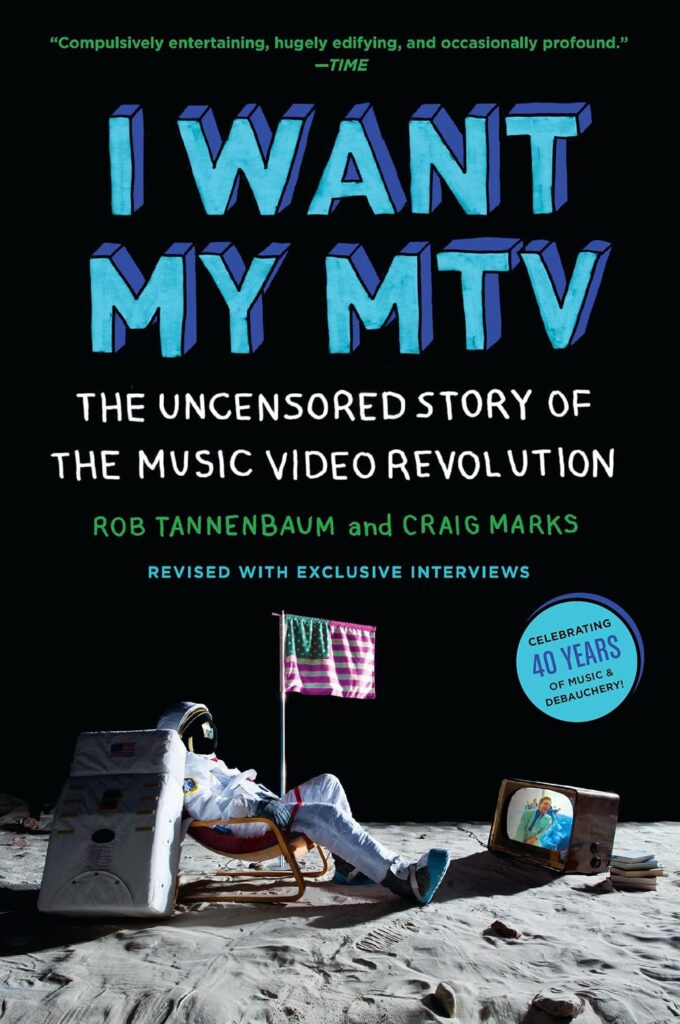
In the meantime, if you’ re feeling nostalgic and would love to read or listen to more stories about MTV’s glory days, check out I Want My MTV by Rob Tannenbaum and Craig Marks.
“Featuring interviews with nearly four hundred artists, directors, VJs, and television and music executives, I Want My MTV is a testament to the channel that changed popular culture forever.“
*As an Amazon Associate, The Songbird Soundtrack earns commissions from qualifying purchases.