
As an Amazon Associate, The Songbird Soundtrack earns commissions from qualifying purchases.
A few weeks ago, in “Nothing Ever Lasts Forever: Songs for the Last Days of Summer,” I mentioned one of the first signs that summer was slipping away. Remember the marching bands? Brass and woodwind players running scales in school parking lots. Color guard flags snapping in the breeze. Percussion cadences carrying a little farther than you’d expect.
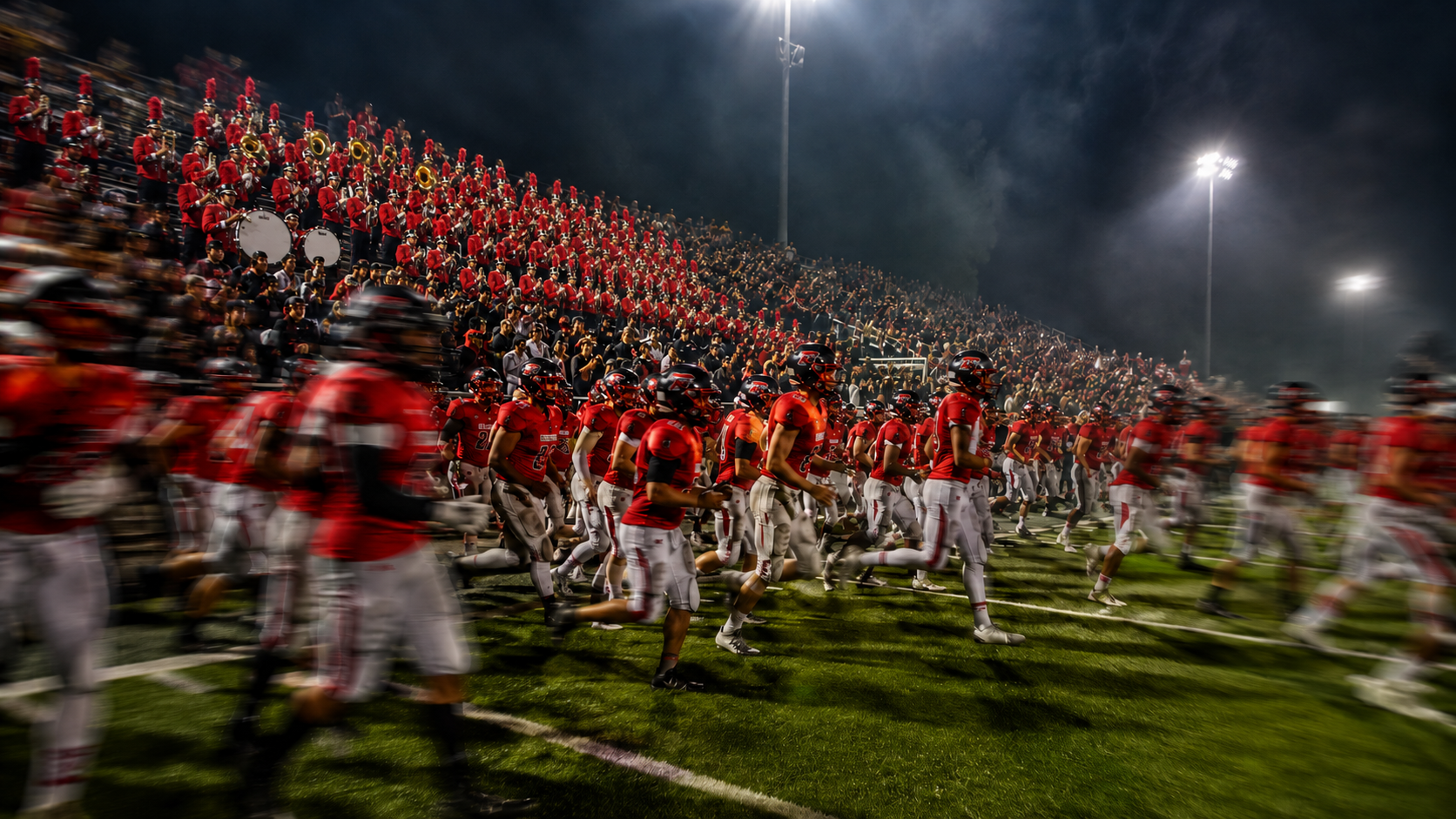
Just days after the band starts practicing, the football team moves from the weight room to the field. Players don helmets and shoulder pads. Coaches start blowing whistles. Lines appear on the grass.
The weather may still insist it’s summer (especially here in Texas!), but we know better.
Friday night’s coming.
Here in Texas, Friday night means football. And here in Texas, for many high school teams, the season begins this Friday. Some teams even begin tonight.
I learned just how much football could matter to a small town during my first year as a band director in a small 3A high school town. That season, our football team tallied win after win, and every week, the school and the community got more invested in and excited about what might happen next.
Could we win again this Friday? How far could this team go?
As it turned out, the team (and the community) would go all the way to the state championship game in December. In fact, I still have vivid memories of a halftime show we did that featured Santa Claus!
Unfortunately, we lost. But for just a little while, everyone in that community was part of the same story.
Although I’m not a band director anymore, that might be one reason Friday Night Lights is still one of my all-time favorite TV shows. It understood the importance of the story. Football brought everyone to the field, but the game was never the only thing happening there.
Jason Street began as Dillon’s golden boy, the star quarterback with a future everyone thought was already written. Then one tackle changed everything. And QB1 had to figure out who he was when he couldn’t be QB1 anymore.
Matt Saracen was QB2, the quiet backup who stepped onto the field because someone had to. He didn’t go looking for the spotlight, but suddenly, the spotlight was thrust upon him, and his team needed him. Meanwhile, he was taking care of his grandmother and trying to keep the rest of his life from falling apart.
Smash Williams believed football could carry him somewhere bigger. He had the talent and the confidence, but he also carried the pressure of knowing football might be his best chance to build a life beyond Dillon.
Tyra Collette wanted out of Dillon. She didn’t always believe she was college material, and plenty of people around her seemed willing to agree. But Tami Taylor wasn’t one of them. She saw something in Tyra that Tyra didn’t always see in herself and kept pushing her to imagine a bigger future.
Landry Clarke was Matt’s best friend and one of the few people in Dillon who didn’t seem particularly impressed by football. At least not at first. He was smart, awkward, funny, and fiercely loyal to the people he loved. Eventually, even Landry found himself wearing an East Dillon uniform.
Julie Taylor grew up in a family whose life revolved around football, whether she wanted it to or not. She spent much of the series trying to figure out who she was beyond being Coach Taylor’s daughter. Her choices were messy, which probably made them more believable. Growing up usually is.
Lyla Garrity thought she knew exactly how her life would unfold until Jason’s injury took that future apart. She had to reconsider her relationships, her faith, and the carefully planned life she had expected to live.
Lyla’s father, Buddy Garrity was a former Dillon Panther, a car dealer, an enthusiastic booster, and the self-appointed guardian of Dillon football. He could be overbearing, opportunistic, infuriating, and hilarious funny — often without meaning to be. But beneath all of that, Buddy genuinely loved the team, the town, and Coach Taylor. When Coach moved to East Dillon, Buddy eventually followed, proving that his loyalty could stretch beyond the blue-and-gold uniform he had treated almost like a religion.
Then there was Tim Riggins.
A study in contrasts, Tim could be loyal, reckless, self-destructive, and unexpectedly tender — sometimes all in the same episode. Dillon seemed to be both the place holding him back and the only place he really belonged.
Coach Taylor had to balance winning games with his responsibility to the young men playing them. And Tami kept reminding him (and often, the entire town of Dillon) that those young men were still students and teenagers whose lives had to matter beyond football.
Fair warning: we’re going to talk about how some of those stories ended. Yes, the finale aired back in 2011. Still, spoilers ahead.
- Jason didn’t get the life Dillon expected him to have. But he built another one. He became a sports agent, married Erin, and became a father to their son, Noah.
- Tyra made it to the University of Texas. Landry went to Rice. Lyla went to Vanderbilt. Julie’s wandering path eventually led her back to Matt, who had begun building a life of his own in Chicago.
- Smash lost the scholarship he thought would carry him out of Dillon, but Coach Taylor didn’t give up on him. He helped Smash train for another opportunity, and Smash earned a place at Texas A&M.
- And Tim stayed in Texas, bought his own land, and started building a home there. Somehow, that felt exactly right.
But maybe the biggest change belonged to Coach Taylor. For years, Tami had supported his career, moving where football took their family and helping him hold everything else together. In the finale, Coach finally turned that around. He stepped away from the opportunity waiting for him in Texas and followed Tami to Philadelphia so she could pursue her dream.
Nobody ended up exactly where they expected.
I think that was the point.
“Clear eyes, full hearts, can’t lose” may have begun as the Dillon Panthers’ rallying cry, but it came to mean much more. It was about how you showed up with courage, loyalty, and your whole heart. Even when winning was far from guaranteed.

Friday Night Lights Clear Eyes. Full Hearts. Can't Lose! T-Shirt
Some of these songs take us directly onto the field. We’ll hear about quarterbacks, touchdowns, coaches, cheerleaders, and the boys who become local heroes beneath the Friday night lights.
Others use football to talk about something else entirely.
We wait for someone to make the call. We get blindsided. We drop the ball. We move the goalposts. We’re handed opportunities, fumble them, and hope there’s still enough time to try again.
Football has given us a whole language for the rest of life.
This playlist begins with the lights, the marching band, and the pep rally. From there, football becomes a metaphor for relationships, pressure, disappointment, memory, and what happens when the original play doesn’t work.
Because on the field and off, things rarely go exactly as planned.
Friday Night Lights Theme Tune — London Music Works (2012)
There really wasn’t another way to begin.
A few notes of the Friday Night Lights theme, and we’re back in Dillon. The stadium lights come on. The players take the field. Coach Taylor gives one of those speeches that makes us believe everything might be all right — even when we know it probably won’t be.
The original television theme was composed by W.G. Snuffy Walden. It’s often credited to Explosions in the Sky, probably because the band’s
Unfortunately, the original version isn’t available to us on Spotify, so the playlist uses the London Music Works recording. For the video, though, we’re going back to the real opening credits.
Texas is waiting.
Tusk — Fleetwood Mac (1979)
Here comes the marching band.
“Tusk” isn’t about football. It may be the biggest outlier on this playlist, and that’s exactly why it belongs here.
In June 1979, Fleetwood Mac recorded the song with 112 members of the USC Trojan Marching Band at Dodger Stadium. The band marched while playing, which made recording them a little more complicated — and helped give “Tusk” the strange, slightly unruly energy that makes it impossible to mistake for anything else. ESPN revisited the story behind the collaboration.
Marching bands are part of the sound of football season. They’re there before kickoff, during halftime, and in the stands when the team needs one more reason to keep going.
And sometimes they end up on a Fleetwood Mac record.
That works, too.
Pep Rally — Missy Elliott (2016)
The band has arrived. Now we need a pep rally.
Missy Elliott released “Pep Rally” on Super Bowl Sunday in 2016, one year after appearing with Katy Perry during the halftime show. The song also appeared in Amazon’s “Baldwin Bowl Party” Echo commercial with Alec Baldwin, Jason Schwartzman, and former NFL quarterback Dan Marino.
Subtle? Not especially.
Fun? Absolutely.
Every school seems to have its own pep-rally traditions. There are cheers no one outside the district would understand, teachers talked into participating in questionable games, and at least one microphone that stops working at the worst possible moment.
But for a few minutes, everyone believes.
Or at least everyone is making enough noise to sound like they do.
The Boys of Fall — Kenny Chesney (2010)
Too obvious?
Of course it is.
“The Boys of Fall” may be the first song people think of when someone says “songs about football.” Kenny Chesney has said it describes how and where he grew up, and the song doesn’t pretend football is merely a game. It’s about the work, the friendships, the responsibility, and the knowledge that this particular season of life won’t last forever.
The eight-minute video debuted on ESPN’s SportsCenter and includes players and coaches talking about their own experiences with high school football. Parts of it were filmed in Celina, Texas, a town that knows more than a little about winning football games.
But the reason the song lasts isn’t the winning.
It’s the looking back.
Eventually, every player reaches a final game. Years later, the score may be difficult to recall, but the people who stood beside him usually aren’t.
This Town — Joe Purdy (2001)
“In this town, there was a Friday night football game.”
That’s how Joe Purdy begins, and with one line, we know where we are. The high school stadium. The quarterback. The cheerleader. The people watching from the stands and the stories unfolding where everyone can almost — but not quite — see them.
The game is part of the story, but it isn’t the entire story. Football gives the town a place to gather while relationships form, secrets spread, and people make decisions they’ll have to live with later.
Very Friday Night Lights, isn’t it?
Highschool Football Hero/Man in a Suitcase — AFI (1995)
Not every football hero grows up to deliver an inspirational speech in a documentary.
AFI’s “Highschool Football Hero” takes aim at the stereotype instead: the athlete who expects touchdowns, beer, and local celebrity to excuse just about everything else. It’s fast, sarcastic, and over before anyone has time to become too comfortable.
The Spotify track also includes AFI’s hidden cover of the Police song “Man in a Suitcase.” On the original version of Answer That and Stay Fashionable, the cover arrived after listeners thought the album had ended.
The football hero in the first half of the track knows exactly who he wants to be. Unfortunately, that person isn’t especially interested in academics, consequences, or what happens after high school.
There’s more than one way to lose your way. Sometimes it happens while everyone is still cheering.
The Sporting Life — The Decemberists (2005)
We’re taking a little creative license with this one.
“The Sporting Life” is most likely about soccer. But soccer is football to most of the world, right?!
Besides, the sport itself isn’t the most important part of the song. The narrator is lying on the playing field after making a mistake. His coach is angry. His father is disappointed. His girlfriend appears to have found someone else.
The
Of course, anyone who has ever disappointed a coach, a parent, or a crowd knows it doesn’t feel like one small moment at the time.
Sometimes finding your way begins by admitting that everyone else’s idea of success may not be yours.
Backfield in Motion — Mel & Tim (1969)
Now football leaves the field and becomes a relationship metaphor.
Mel & Tim aren’t worried about an actual penalty. Someone has been moving in the wrong direction with someone else, and the officials — if there were any — would definitely throw a flag.
Released in 1969, “Backfield in Motion” reached No. 10 on the Billboard pop chart and No. 3 on the R&B chart. It remains one of the smartest uses of football terminology in a love song.
Football gives us plenty of useful relationship language. Someone can move too fast, cross a line, interfere, change the play, or run in entirely the wrong direction.
No helmet required.
Quarterback — Wallows (2021)
Being the quarterback sounds like being in control.
This song knows better.
Wallows turns the position into a metaphor for a relationship in which someone is waiting for a call that may never come. There’s attraction and uncertainty, but no clear play — and no guarantee that both people are even reading from the same book.
“Quarterback” also gave drummer Cole Preston an unusual turn as the band’s lead vocalist. The idea had been around for years before Wallows brought it back while working on the expanded version of the Remote EP.
It’s bright and catchy enough to disguise how unsure everything feels underneath.
Sometimes the person who seems to be calling the plays is also waiting for someone else to tell him what happens next.
Football — Iggy Pop (2001)
If the previous song made us the quarterback, Iggy Pop has another position in mind.
We’re the ball.
Passed. Kicked. Fumbled. Knocked from one end of the field to the other.
Well, isn’t that encouraging?
“Football” appeared on Iggy’s 2001 album Beat ’Em Up, and it isn’t interested in making the metaphor gentle. Life can feel like something happening to us while other people call the plays.
Maybe we’re moving forward. Maybe we’ve been intercepted. Maybe we’re simply trying to survive the next hit without losing possession of ourselves.
One of the stranger choices on the playlist? Maybe so. A decent metaphor for how we’ve all felt at one time or another? Absolutely.
All Kinds of Time — Fountains of Wayne (2003)
For one play, everything slows down.
The quarterback drops back. The protection holds. The receivers move downfield, and suddenly he can see every possibility in front of him.
He has all kinds of time.
The phrase came from the familiar language of NFL commentators, but Fountains of Wayne turned it into something much bigger. The song captures that rare moment when the noise falls away and the next move becomes clear.
It may be the most hopeful song here.
Most of life doesn’t give us all kinds of time. Decisions arrive too quickly. Plans collapse. Defenders break through. But every once in a while, the pocket holds.
This is what we do with that moment.
Mudfootball (For Moe Lerner) — Jack Johnson (2001)
Before football became pressure, scholarships, packed stadiums, and carefully drawn plays, it may have been this.
A group of friends. A pickup truck. A muddy field. No matching uniforms and probably no one keeping a particularly accurate score.
Jack Johnson’s “Mudfootball” looks back at those games from the other side of growing up. The details that once seemed ordinary have become the things worth remembering.
That’s what time does.
The game that felt as if it would go on forever becomes a story. The people who played it scatter. Eventually, someone says, “Remember when?” and everyone who was there can see the field again.
Clear Eyes, Full Heart (Can’t Lose) — T. Powell (2014)
We had to end here.
T. Powell’s “Clear Eyes, Full Heart (Can’t Lose)” isn’t part of the official Friday Night Lights soundtrack. It takes the Dillon Panthers’ rallying cry and turns it into a motivational track of its own.
The phrase is slightly different — the show gave us “Clear eyes, full hearts, can’t lose,” while the song title uses the singular “heart” — but the idea remains.
And here’s the thing: the Dillon Panthers did lose. Yes, they won the state championship in Season 1, but they had losses when Coach Taylor left for a stint at TMU, and they suffered devastating loss after a fierce second half comeback in the Season 3 State championship.
The East Dillon Lions lost, too. A lot. Until they beat the West Dillon Panthers in the Season 4 Thanksgiving Rivalry Game. The team from the small school district where I taught lost in its state championship game I mentioned.
The season ends that way for almost every team.
“Can’t lose” was never a promise about the scoreboard. It was a way to enter the game. See clearly. Care completely. Give everything you have. Then face whatever happens next.
Football has a way of turning ordinary nights into markers of time. Years later, people may forget the score, but they remember the lights, the sounds, the people sitting beside them, and how it felt to believe the next play might change everything.
A season can end in a loss and still become part of a school’s story. A player can leave the field without becoming the hero everyone expected and still carry something valuable away. Even the people in the stands become part of the memory.
That’s what these songs share. They aren’t simply about winning football games. They’re about everything we bring with us beneath the lights. And they’re about everything we take home when those lights finally go out.
Clear eyes. Full hearts. Can’t lose.
Texas forever.

A Friday Night Lights tee for anyone who knows “Texas forever” is more than a line.