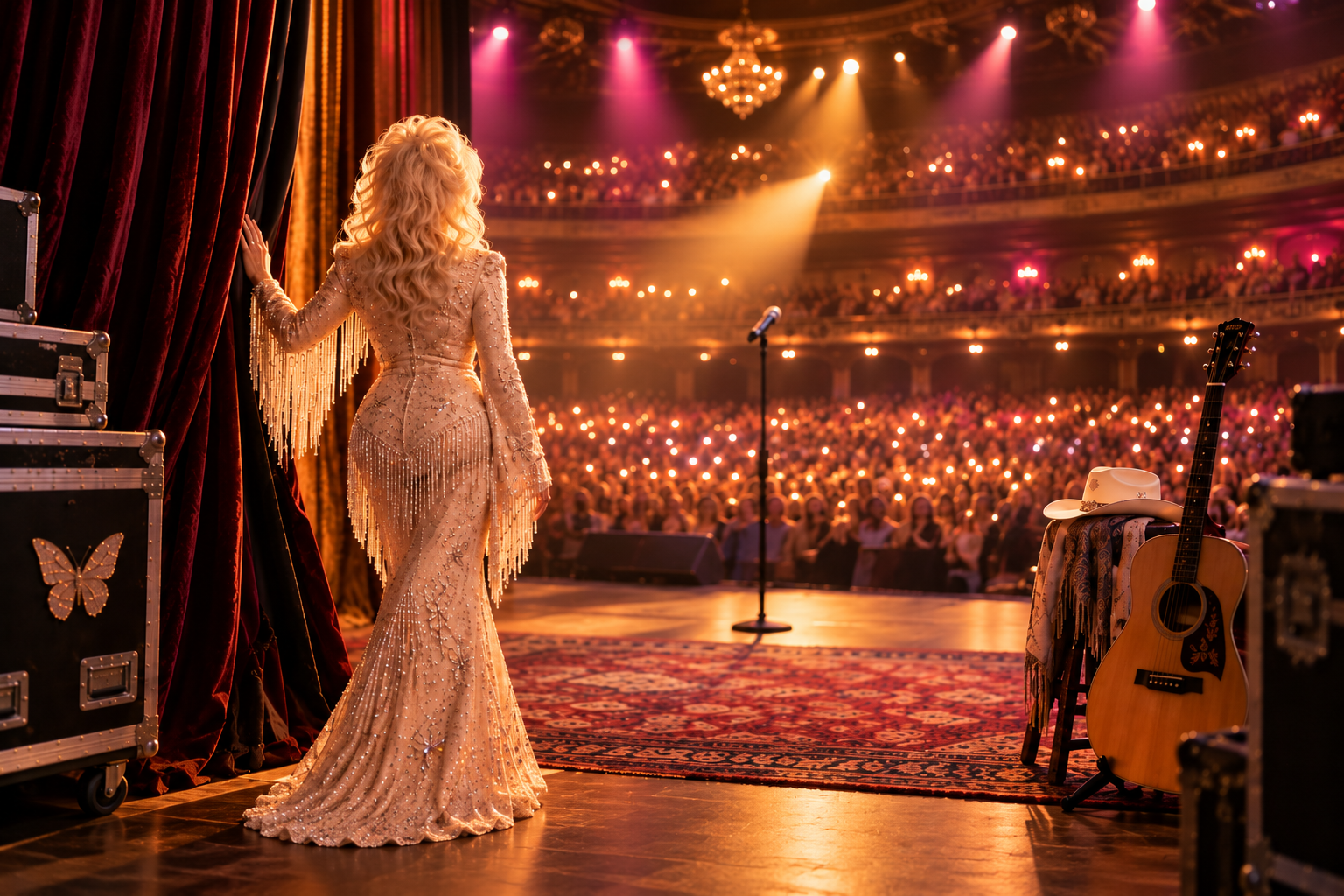
Where I've Been and Where I'm Going: The Songs That Found Dolly
Here we are, almost two weeks later, and, like so many people, I’m still thinking about Dolly Parton.
When I composed my previous playlist, I wanted to hear the songs Dolly gave us — the ones she wrote, the ones that carried her stories, her humor, her heartbreak, her faith, and her way of seeing people.
But I kept coming back to something else. Dolly Parton was such a remarkable songwriter that it’s easy to forget how good she was at recognizing a great song when somebody else wrote it.
Sometimes the song arrived already famous. Sometimes it became famous because Dolly sang it. Sometimes she took something so closely associated with another artist that covering it seemed almost reckless, and then somehow made it sound as if it had been waiting for her all along.
So this time, I wanted to listen to the songs that found Dolly.
Here You Come Again — Dolly Parton — 1977
I thought Dolly wrote this song. That’s how completely “Here You Come Again” belongs to her in my memory.
I remember hearing it when I was around middle-school age, and even then, it felt like something was changing. Dolly was still Dolly, but suddenly she was everywhere — not just on country radio.
Barry Mann and Cynthia Weil actually wrote “Here You Come Again,” and Dolly’s recording became one of the songs that carried her across that country-pop line. It topped the country chart and reached No. 3 on the Billboard Hot 100. The song’s recording history also says a lot about the balancing act Dolly was attempting.
She wanted to broaden her audience without losing the sound that connected her to country music. Producer Gary Klein later recalled that Dolly pushed for steel guitar in the arrangement, and the resulting session found that middle ground.
That feels like Dolly in miniature: willing to go somewhere new, but determined to sound like Dolly when she got there.
Islands in the Stream — Kenny Rogers & Dolly Parton — 1983
Here’s another one I assumed belonged to Dolly. It doesn’t.
Barry, Robin, and Maurice Gibb — yes, the Bee Gees — wrote “Islands in the Stream.” I didn’t know that until I started putting this playlist together, which may be the best proof of how completely the song became Kenny and Dolly’s.
Kenny Rogers later told the story of struggling with the song in the studio until Barry Gibb suddenly decided they needed Dolly. As luck would have it, she was nearby. She came in, and Kenny later said:
“Once she came in, the song was never the same.”
That may be the whole story of Dolly as an interpreter in one sentence. She didn’t write the song, and she wasn’t even there at the beginning of the recording process. But once Dolly walked into the room, it became almost impossible to imagine “Islands in the Stream” without her.
And for a post called The Songs That Found Dolly, I love that this one almost literally did.
Shine — Dolly Parton — 2001
I already loved the Collective Soul version of “Shine” long before I knew Dolly had even recorded it.
I remember hearing it and thinking, “Wait. Dolly Parton recorded ‘Shine’?” But as I listened, I couldn’t help but love what she did with it.
Dolly didn’t try to reproduce the Collective Soul record. She heard something else inside the song. She later explained that she and Carl had loved the original for years, but underneath all that rock, she heard something spiritual, and she thought the melody could work with bluegrass harmony.
That explanation may be one of my favorite things I learned while putting this playlist together, because that’s what Dolly seemed to do so well with somebody else’s song: hear past the arrangement that was already there and ask what else the song might be.
Collective Soul frontman and “Shine” songwriter Ed Roland loved what she found. Asked about Dolly’s rendition, he said:
“I thought it was one of the most beautiful things ever.”
There’s another detail I love. Roland remembered finding out from his father that Dolly was going to perform “Shine” on Late Night with David Letterman. He watched the performance and sent her flowers afterward.
I still love Collective Soul’s version. But Dolly’s “Shine” reminds me that a great song can have more than one natural home.
Stairway to Heaven — Dolly Parton — 2002
There are some songs you’re supposed to leave alone, and “Stairway to Heaven” may be somewhere near the top of that list.
Dolly apparently didn’t get that memo.
But she didn’t record it just to prove she could. Carl loved Led Zeppelin, and Dolly said “Stairway to Heaven” had become something like their song — one of those songs they would listen to together in the car.
Once again, what interests me most is what Dolly heard inside the song. In a 2002 CNN interview, she said she had always thought of “Stairway to Heaven” almost as a gospel song — someone trying to buy their way into heaven. So instead of chasing Led Zeppelin’s sound, she leaned into what she heard there, using bluegrass instrumentation, a choir, and her own interpretation of what the song could become.
And when someone suggested she might be stepping onto sacred rock-and-roll ground, Dolly had the perfect response:
“At my age, who am I going to be afraid of? Just Led Zeppelin?”
That may be one of my favorite Dolly quotes, period. Coming right after “Shine,” this tells us something important. Dolly wasn’t simply turning rock songs into bluegrass songs. She was listening underneath the genre.
Something’s Burning — Dolly Parton — 1996
“Something’s Burning” is here partly because it’s unexpected, but it also ties together a couple of threads already running through this playlist.
Kenny Rogers and the First Edition had the hit, so Kenny returns to the story after “Islands in the Stream.” And Mac Davis wrote it — a name we’ll see again in a few songs.
Dolly recorded “Something’s Burning” for Treasures, an entire album built around songs written and made famous by other people. This one doesn’t need a long explanation. I just like the way Dolly gives it a little more edge and reminds us that not every song that found her had to arrive carrying some huge statement.
Sometimes a song just fit.
![Treasures by Parton, Dolly [Music CD]](https://m.media-amazon.com/images/I/415l43ckhTL._SL500_.jpg)
What’s Up? — Dolly Parton featuring Linda Perry — 2023
I just love “What’s Up?”
I loved the 4 Non Blondes original long before Dolly recorded it, so I was already interested when I saw it on Rockstar, Dolly’s 2023 rock album built largely around songs from rock and pop history, often with some pretty remarkable guests.
What makes Dolly’s version especially good is that Linda Perry isn’t standing somewhere off to the side giving her blessing. She’s there.
And Perry’s reaction to Dolly’s version could almost be the subtitle of this entire post:
“Her spin on it made me feel like it was her song.”
Exactly. Dolly didn’t erase the original, and she didn’t need to. She simply stepped into the song and somehow shifted its center of gravity.
Dolly said she loved Linda, loved the song, and wanted the video to make people think about what was happening in the world. The official video brings the two of them together, which makes the whole thing feel less like a cover and more like a conversation between the woman who wrote the song and the woman who heard something new in it.
And somehow, more than 30 years after the original, “What’s Up?” has found yet another life. It has had a whole new moment on social media, reaching another generation of people who apparently also need to throw their heads back every now and then and ask what’s going on.
Linda Perry has seemed amused by the whole thing, which feels fitting. Perry wrote it, 4 Non Blondes made it famous, Dolly made it sound like hers, and now everybody seems to own a little piece of it.

Wrecking Ball — Dolly Parton featuring Miley Cyrus — 2023
This one gets me.
Dolly said the first time she heard “Wrecking Ball,” she almost cried in her car. When the chorus hit, she said it hit her exactly the way the title says it should — like a wrecking ball.
I understand that. I’m a godmother myself, and my goddaughters joke that they can make me cry pretty easily. (They’re right.)
There can be something incredibly tender about the relationship between a godmother and a goddaughter — part family, part friendship, part mentorship, and part simply being one more person who’s always in their corner. So when Dolly said “Wrecking Ball” nearly made her cry, I understood exactly why.
Dolly wasn’t simply borrowing a younger artist’s hit. She was singing beside someone she’d loved, encouraged, and watched grow up. And Miley wasn’t simply handing over one of her songs to Dolly. They were meeting inside it.
Sometimes, special relationships make you a little more emotionally defenseless, in the very best way.
And how can you not love the nod to “I Will Always Love You” at the end of this duet? Chef’s kiss.
Both Sides Now — Dolly Parton featuring Rhonda Vincent & Judy Collins — 2005
I knew “Both Sides Now” when I was younger. I understood the words then — sort of intellectually, maybe — but I hadn’t lived enough of them yet. I understand them differently now.
Some songs don’t really change, but we do.
Joni Mitchell wrote and recorded “Both Sides Now,” and Judy Collins made one of the song’s best-known early recordings. Having Collins join Dolly here already brings decades of history into the room.
Then there are the harmonies. I’m an alto, so I rarely listen only for the melody. I hear the line underneath it — the one that supports, answers, and sometimes changes the whole emotional color of the song. Maybe that’s part of why this arrangement gets to me so much. But it’s more than that. I was sitting here listening to it again while working on this post, and I was in tears.
This isn’t a particularly quiet arrangement. It has movement, lift, and life in it. Maybe that makes it even more appropriate for this playlist. “Both Sides Now” is a song about perspective — about realizing that the same things can look entirely different, depending on where you’re standing — and for me, at least, the different voices in this version embody that idea.
Joni’s writing, Judy’s history with the song, Rhonda, and finally Dolly. Several lifetimes meeting in the same place.
There’s wisdom here without stillness, and today, that’s hitting me right in the feels.
The Twelfth of Never — Dolly Parton featuring Keith Urban — 2005
I first learned of “The Twelfth of Never” by listening to my mother’s LPs when I was a kid and hearing Johnny Mathis’ version. In a completely non-musical way, my sister and I have joked for years that when somebody asks us when we’re going to do something we know we don’t want to do, the answer is always, “On the twelfth.” For that reason, I always kind of chuckle when I hear this song.
Keith Urban has his own relationship with the song. Long before he was a star, he was a teenager in Australia, working as a musical director for a cabaret singer, and “The Twelfth of Never” was one of the songs he had to learn. He remembered wondering when he would ever need it again.
About 20 years later, he was standing in a studio with Dolly Parton. She told him: “You probably won’t know this song.”
Keith’s answer? “Strangely enough, I do!”
I love that story. A song Keith Urban probably thought he would never need again had apparently been waiting for him all those years, until eventually it led him into a studio with Dolly.
In the Ghetto — Dolly Parton — 1969
I’m probably in the minority, but “In the Ghetto” has never been one of my favorite Elvis songs. I can’t quite put my finger on why; it just hasn’t. My dad loved it, though, which probably explains why I felt almost obligated to include it.
So before Dolly ever enters the picture, for me, this song already comes with someone else’s memory attached.
There’s another Elvis-and-Dolly connection worth remembering here, too. Elvis wanted to record Dolly’s “I Will Always Love You,” but Colonel Tom Parker wanted part of the publishing rights, and Dolly wouldn’t give them up. Dolly later told Dan Rather how painful that decision was, even though she knew the publishing was too important to give away.
With “In the Ghetto,” the exchange goes the other direction: Dolly steps into one of the songs most closely associated with Elvis.
Mac Davis wrote “In the Ghetto” out of memories from his childhood in Lubbock, Texas (another connection for me because I went to college there), where he had a Black friend whose family lived in a much poorer part of town. Davis later talked about not understanding why their lives looked so different. He originally thought of the idea as “The Vicious Circle” — one child born into poverty, growing up inside it, and another child arriving to repeat the pattern.
Interestingly, another connection to a song earlier in the playlist exists, too: Mac Davis also wrote “Something’s Burning.” Same songwriter, very different song.
Elvis recorded “In the Ghetto” in early 1969. Dolly recorded hers on June 2, 1969, while Elvis’ version was still fresh in everyone’s ears. That makes Dolly’s version feel less like nostalgia and more like response — hearing a song that mattered and deciding she had something to say with it, too.
Peace Train / Isitimela Sokuthula — Dolly Parton featuring Ladysmith Black Mambazo — 1996
I didn’t expect this song at all.
The Cat Stevens 1971 version of “Peace Train” already had a very specific identity in my mind; I remember it from my childhood. But then Dolly brought in Ladysmith Black Mambazo and turned it into something much bigger — communal, global, and even spiritual.
The story behind that choice makes it even better. Dolly had wanted to record the song for years, but she couldn’t find the sound she was hearing in her head. Then she heard Ladysmith Black Mambazo in a LIFE SAVERS candy commercial, and suddenly, she knew.
Those were the voices she had been waiting for.
What I love even more is where those voices took Dolly. She said their Zulu singing reminded her of the church services she grew up with — services connected to the Pentecostal tradition of her childhood, where her grandfather was a Pentecostal preacher — and of hearing people speak in tongues. Dolly spoke openly about that Pentecostal upbringing throughout her life.
Once again, Dolly heard something unfamiliar and found something familiar inside it: East Tennessee, South Africa, Cat Stevens, Ladysmith Black Mambazo, and Dolly Parton, all somehow belonging in the same song.
Maybe that’s why this arrangement feels so different from a straightforward cover. Peace doesn’t sound like one voice here. It sounds like a whole world of them.
The Story — Dolly Parton — 2017
“The Story” has been part of The Songbird Soundtrack almost from the beginning, but I hear it differently now.
This summer, my bestie and I went to Austin for Brandi Carlile’s induction into the Austin City Limits Hall of Fame. Another of our favorites, Bonnie Raitt, inducted her.
As I remember watching an artist I’ve followed for years receive that kind of recognition, I keep thinking about how much weight certain songs gather over time.
When Brandi put together Cover Stories to mark the tenth anniversary of the album that made “The Story” one of her signature songs, she invited other artists to re-record its songs.
Dolly got the title track.
Brandi later said she was “aiming really, really high” when she asked Dolly. But Parton enthusiastically accepted the invitation to record. People magazine reported that once Carlile heard the finished version, she realized she’d been “one-upped.”
“Every gratuitous and show-offy note that I hit in that song, Dolly hits it initially and then takes it higher. She just completely takes me to school.”
After eleven songs about Dolly finding herself inside somebody else’s words, maybe “The Story” just had to come this close to the end of this playlist.
By the time we get here, we’ve already heard a lot of Dolly’s story, just not always in her own words. We’ve heard the songs that crossed over with her, the songs she pulled into bluegrass, the songs she shared with people she loved, the songs that reminded her of home, and the songs that reflected something about what she believed.
And there’s one more circle that feels especially poignant now. Just days ago, Brandi Carlile joined I’m With Her in a tribute to Dolly, singing “Coat of Many Colors” after Dolly was honored posthumously at the Americana Honors & Awards.
Brandi made “The Story” famous. Dolly sang it back to her. And years later, Brandi helped sing Dolly home.
There Was Jesus — Zach Williams & Dolly Parton — 2019
“There Was Jesus” is the exception to the premise of this playlist. It isn’t here because Dolly took somebody else’s famous song and transformed it. It’s here because I couldn’t imagine ending anywhere else.
While finishing the demo for “There Was Jesus” for his 2019 album Rescue Story, Zach Williams joked with his producer that it would be incredible to get Dolly Parton to sing on the track. At the time, the idea seemed like a long shot. But after Williams played the demo for his wife and she encouraged him to pursue it, he and his team eventually reached out to Parton. Parton agreed to listen, and Williams later recalled that she knew very quickly that she wanted to be part of the song.
The two met in Nashville, where they spent several hours recording together, and during the session Parton reportedly predicted that Williams would win a Grammy for the song. She was right: “There Was Jesus” went on to become a No. 1 Christian hit and won Best Contemporary Christian Music Performance/Song at the 2021 Grammy Awards.
Dolly never seemed interested in turning faith into a lecture, but she was never vague about where it fit in her life. In a CNN remembrance that revisited her own words, she summed up her priorities in four simple words:
“God first, me second.”
We’ve spent this whole playlist hearing about who Dolly was:
- The country girl who crossed over
- The songwriter who knew when somebody else had written something worth singing
- The woman who heard bluegrass and gospel inside rock songs
- The friend, collaborator, and godmother
- The wife who remembered the songs she and Carl loved listening to
- The singer who could hear the sounds of South Africa and remember the church of her Tennessee childhood
Earlier in the playlist we heard Dolly cover “Stairway to Heaven,” a song some have claimed is about greed and trying to buy your way into heaven. But by the time we reach the playlists’s end, we see that for Dolly, the idea was much less complicated.
For Dolly, there was Jesus.