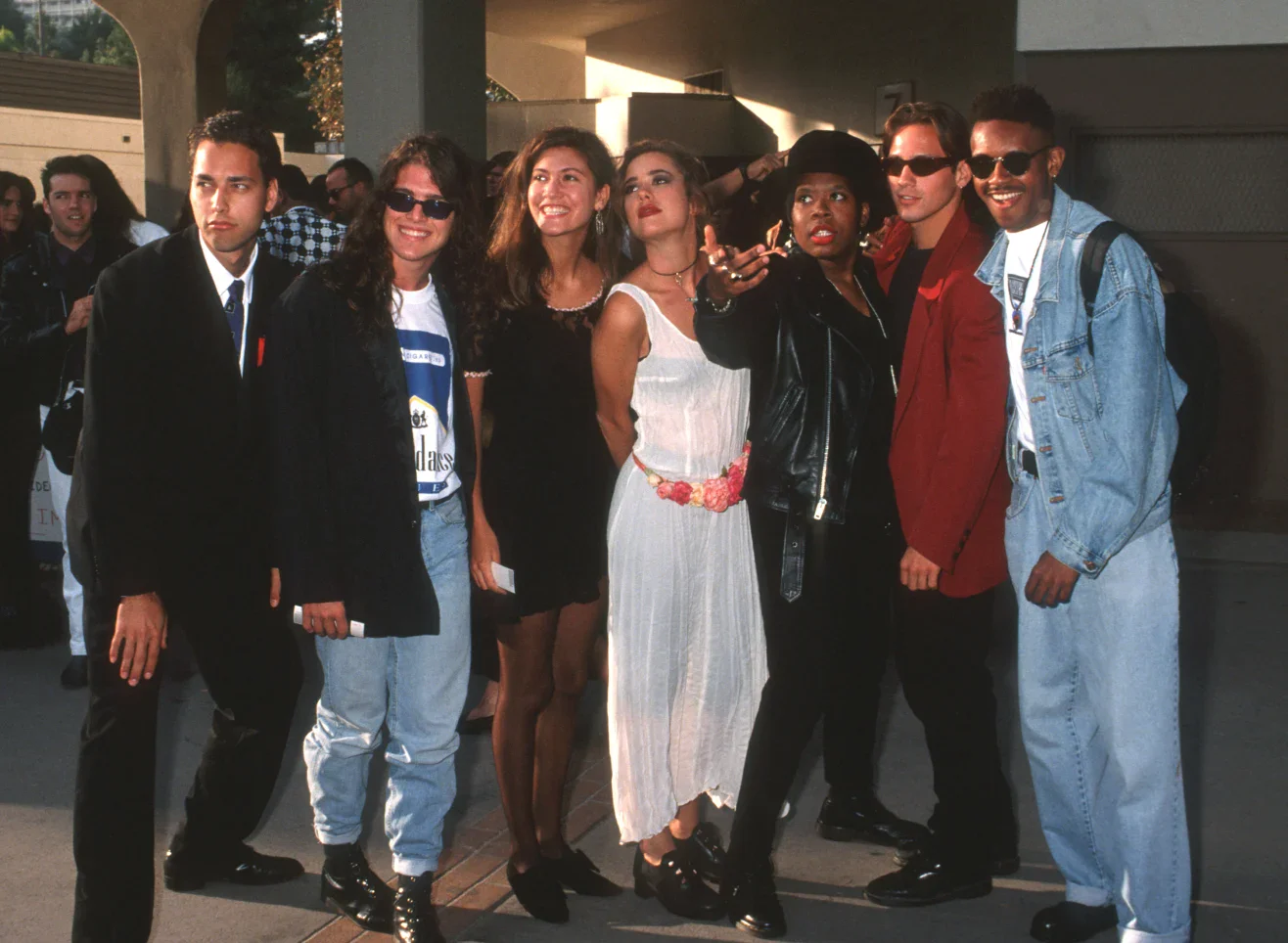

FEATURED IMAGE: The first season of The Real World debuted on May 21, 1992. The cast was composed of Norman Korpi, Andre Comeau, Julie Oliver, Rebecca Blasband, Heather B., Eric Nies, and Kevin Powell, who shared a SOHO loft in New York City. Photo by Ron Galella, Ltd./WireImage/Getty Images
In our previous post, we followed MTV from its audacious 1981 launch through the years when
Then MTV opened a door…
The Doorway
In 1992, MTV introduced seven strangers, put them together in a SoHo loft, and began their story with an introduction that would become part of television history:
This is the true story of seven strangers, picked to live in a house, work together, and have their lives taped, to find out what happens when people stop being polite … and start getting real.
The Real World didn’t end MTV’s
Music videos were still there. They just had to begin making room.
I watched The Real World for its first three or four seasons, although I was already a little outside its target age. In 1992, I was about the same age as Kevin Powell, the oldest of the original seven, and just under ten years older than Julie Gentry. I was also working full time and watching less television.
Maybe that slight distance made the machinery easier to see. The people were real, but some of the conflict already felt less spontaneous than arranged, an early version of what we might now call “manufactured controversy.”
That tension was present from the beginning. Co-creator Mary-Ellis Bunim described the producers’ small interventions as “throwing pebbles in the pond,” nudges intended to create ripples without openly scripting the cast.
Reality television would eventually become far more skilled at turning those ripples into storms. We learned to watch not only the people onscreen but also the invisible hand of the producer: the suggestive question, the conveniently timed entrance, the conflict sharpened in the edit.
The Real World began by promising us the true story.
But it wasn’t the whole story.
It was the doorway to what came next.
The show quietly demonstrated that people would stay with MTV even when the
It was one of those early pebbles, set to a pop song.
MTV Asks Us to Choose
For a while, Total Request Live offered something like a compromise. MTV still showed videos, but now viewers helped decide which ones mattered. Fans voted, crowded into Times Square, held up handmade signs, and waited for Carson Daly to reveal the day’s countdown.
The network no longer simply told young people what to watch. It invited them into the process.
I mostly watched that change from a distance. By the time TRL arrived, I was no longer arranging my day around MTV. But that’s part of this story too. MTV was becoming more intensely youth-centered at the same time many members of its original audience were moving into full-time work, family life, and a more fragmented relationship with television.
Then the screen changed again.
Apple introduced the iPod in 2001 with Steve Jobs’ irresistible promise of “1,000 songs in your pocket.” The iTunes
The sequence mattered: first we carried our
The iPhone completed the merger. When Apple unveiled it in 2007, the company described one device that combined a phone, an internet communicator, and a widescreen iPod. By launch day, it also had a built-in YouTube application.
The television screen that had once gathered everyone in one room had become a private screen we carried everywhere.
YouTube allowed us to search for a particular video, watch it whenever we wanted, replay it immediately, and send it to someone across the world. “Here It Goes Again” didn’t need months of MTV rotation to become famous. “Gangnam Style” could reach a billion viewers without asking whether they spoke the same language. Soon, a song could begin as a TikTok dance, a meme, or a few seconds of sound before its official video even arrived.
The people MTV had once gathered in front of the television scattered across laptops, phones, apps, and social feeds. But we didn’t stop watching
We began choosing it, sharing it, imitating it, parodying it, interpreting it, and sometimes becoming part of the video ourselves.
Thirteen Songs, More Than Thirty Years
At several points, this playlist threatened to become three: one for MTV, one for YouTube, and one for the social-media era.
That actually would’ve been easier.
But the point is the continuity, the way one screen culture became another. The challenge is to tell more than thirty years of change in only thirteen songs.
That means leaving out videos that could anchor entire essays of their own. The final choices aren’t simply the thirteen “best” videos … whatever that might mean. Each one has to represent its moment, advance the larger story, and do work that another selection doesn’t. Popularity matters, but so do invention, cultural memory, and the way a video teaches us something about how
These songs appear in chronological order according to the year of the video or its defining cultural moment. Where an album’s Spotify date differs, the story, not the metadata, determines the placement. And just as before, we’re including only links to videos, not to the individual songs.
“I’m Too Sexy” — Right Said Fred
This isn’t here because it’s the most important video of 1992. It’s here because The Real World itself used the song to shape a story, turning footage of Julie and Eric into a flirtatious montage.
The choice lets the playlist begin at the doorway, with a pop song functioning not merely as entertainment but as an editorial tool.
It also captures the era’s glossy self-awareness. “I’m Too Sexy” makes fun of fashion-model vanity while depending on the image culture it mocks. Fred Fairbrass struts through the video like every room, sidewalk, and catwalk belongs to him.
MTV had always sold cool. Now it could use a song about looking cool to manufacture a possible relationship between two people who were supposedly just being themselves.
The people were real.
The song told us how to interpret them.
“Jeremy” — Pearl Jam
Unlike Fred Fairbrass, Jeremy doesn’t strut into the room. He broods in the corner.
The bass circles ominously beneath the song, and Eddie Vedder’s voice moves from restraint to anguish. The video surrounds Jeremy with rapid images, religious symbols, fragments of text, and classroom scenes that become more disturbing as the song unfolds.
Until recently, I hadn’t really seen the whole video, or at least not in a way I remembered. What stayed with me was the classroom and the final image of Jeremy’s classmates sitting frozen, blood spattered across their clothes. Most of the rest had faded.
That image hadn’t.
In 1992, we couldn’t immediately pause the video, search for an explanation, or replay the ending. We waited for MTV to show it again. The edited ending, which zoomed in on Jeremy’s face so you could see his gun, also created confusion about exactly what had happened, leaving many viewers thinking Jeremy had killed his classmates rather than himself … a different understanding from the one the director intended. (Pearl Jam later released the uncensored version of the video on the band’s YouTube channel on June 5, 2020, to mark National Gun Violence Awareness Day.)
“Jeremy” shows the
We considered “Waterfalls” for a similar reason. TLC used popular television to tell serious stories about risk, loss, and consequence. “Jeremy” stays because it belongs precisely to the 1992 hinge, when the
On the same channel that invited us to watch seven strangers live together, “Jeremy” reminded us how much could remain hidden inside a crowded room.
“I’ll Be There for You” — The Rembrandts
After all the darkness of “Jeremy,” the opening of “I’ll Be There for You” feels like someone turning on the lights.
And what a shift it is: from isolation to friendship, from dread to reassurance, from a classroom no one understands to six people promising to be there for one another. Pearl Jam’s gathering anguish gives way to bright guitar-pop and one of the most recognizable television themes ever recorded.
Those four handclaps were everywhere in the mid-1990s. (You just heard them, didn’t you?)
Friends belonged to NBC’s Must See TV era, when the name was practically an instruction. Before DVRs and streaming services, Thursday-night television happened on Thursday night. If we couldn’t be home, we programmed the VCR, hoped we’d selected the correct channel, and tried not to record over anything important.
The song began as part of that weekly appointment, but it didn’t stay inside the opening credits. It became a radio hit and acquired a full
Then Friends moved into syndication, where the apartments, the coffeehouse, and those handclaps became almost impossible to avoid. Streaming introduced the show to viewers who hadn’t been old enough to join us on Thursday nights, and the theme followed it into another generation.
The technology changed, but the recognition remained immediate.
Before we carried television in our pockets, we arranged our lives around it.
Then television followed us there.
“The Rain (Supa Dupa Fly)” — Missy Elliott
Missy Elliott’s black inflatable suit, the fisheye lens, the gleaming colors, and the sly humor didn’t merely accompany “The Rain.” They announced a complete visual imagination.
At the same time MTV was devoting more space to personalities and programs, artists such as Elliott were proving that the
This was one of the hardest choices in the entire playlist. “Sabotage” turned a Beastie Boys song into a delirious 1970s cop-show trailer. “Tonight, Tonight” borrowed from silent cinema to make alternative rock feel like a hand-built dream.
Missy gets the slot because her video feels less like homage than arrival: a new visual language, a new star, and a future suddenly visible.
“…Baby One More Time” — Britney Spears
By the late 1990s, TRL had turned the
Britney Spears arrived perfectly suited to that system. She was instantly recognizable, endlessly discussable, and supported by a video whose school-bell opening could be identified before she sang a word.
The era also produced “My Name Is,” a barrage of characters and pop-culture parody that made Eminem impossible to ignore. Britney stays because she best represents the countdown economy itself, the moment when fan voting, celebrity persona, choreography, controversy, and repeat viewing became parts of the same machine.
MTV invited viewers to choose.
Britney gave them something they wanted to choose again and again.
“Weapon of Choice” — Fatboy Slim
A solitary Christopher Walken dances through an empty hotel.
Then he flies.
The concept is simple enough to describe in one sentence and strange enough to remain unforgettable. “Weapon of Choice” represents the prestige
Two towering alternatives remain outside the thirteen. Johnny Cash’s “Hurt” turned a cover into a devastating meditation on memory and mortality. Outkast’s “Hey Ya!” staged Beatlemania for a splintering media age.
Walken keeps this slot because 2001 was also the year the iPod arrived. His dance feels like one last magnificent flourish of the
“Vertigo” — U2
“Vertigo” is the playlist’s clearest connection between pop spectacle and the new hardware economy.
U2’s silhouette-filled iPod commercial made the song part of Apple’s promise that
The same period gave us the party-starting force of the Black Eyed Peas’ “Let’s Get It Started,” while Gorillaz’s “Feel Good Inc.” showed how an animated band could exist across recordings, videos, games, and digital identity.
But “Vertigo” tells the technological story most precisely.
It makes the iPod audible.
“Here It Goes Again” — OK Go
Eight treadmills, one locked camera, no apparent edits, and choreography so exact that every possible failure is visible.
“Here It Goes Again” was made to be replayed and forwarded. Its fame didn’t depend on catching it during MTV rotation. People carried it from person to person, link by link.
And then there’s that opening. To me, it has the buoyant, forward-driving snap of a station identification, almost as though MTV’s 1981 launch
Here it goes again, indeed:
The video ended. The dancing didn’t.
“Single Ladies (Put a Ring on It)” — Beyoncé
A white room. Three dancers. Black leotards. Choreography that became a worldwide invitation.
“Single Ladies” proved that visual simplicity could generate almost endless participation. We didn’t merely watch. We learned it, copied it, parodied it, and uploaded ourselves back into the culture.
Choosing one Beyoncé song means leaving out “Formation,” a richer and more explicitly political visual statement. The playlist keeps “Single Ladies” because it marks the earlier structural change.
The video wasn’t finished when Beyoncé released it. What happened afterward, in bedrooms, comedy sketches, wedding receptions, football fields, and countless imitations, had become part of the work.
One of the clearest signs that the dance had become part of the culture came the following year on Glee. In the first-season episode “Preggers,” Kurt Hummel teaches the McKinley High football team the choreography, and the players perform it on the field before a play.
I still remember that scene. It was funny, but it was also strangely triumphant: one of the most traditionally masculine spaces on the show was suddenly moving to Beyoncé’s choreography, with Kurt at the center of it.
The moment worked because Glee could trust that we already knew the dance. No one needed to explain the reference. A routine that began in a Beyoncé video, spread through thousands of online imitations, and then landed on a network television show had completed a kind of cultural circle.
Lady Gaga’s “Bad Romance” would soon prove that extravagant, fashion-driven event videos could flourish online. Sia’s “Chandelier” would make a single dancer’s physical performance instantly iconic.
Both inherited a world in which choreography was meant not only to be seen but also to circulate.
“Gangnam Style” — PSY
“Gangnam Style” made the scale of the new system impossible to miss.
A Korean-language song, propelled by a comic visual performance and an imitable dance, became the first YouTube video to reach one billion views. MTV once created mass simultaneity by broadcasting the same thing to everyone. YouTube created it by allowing everyone to arrive from somewhere else and press play whenever they chose.
Luis Fonsi and Daddy Yankee’s “Despacito” later confirmed that language was no barrier to worldwide reach.
“Gangnam Style” keeps the slot because it was the threshold moment. The number one billion appeared on the screen like a declaration that the old measurements no longer applied.
“This Is America” — Childish Gambino
By 2018, a major video could arrive as both artwork and argument.
“This Is America” rewarded repeated viewing, frame-by-frame interpretation, reaction videos, essays, and debate. We didn’t wait for a VJ to explain why it mattered. The explanation unfolded everywhere at once.
Kanye West’s “Runaway” had already stretched the
“This Is America” gets the slot because its release demonstrates the mature attention economy: shock, symbolism, choreography, interpretation, outrage, and virality all moving at internet speed.
Watching was no longer the end of our participation.
It was the beginning of the conversation.
“Old Town Road” — Lil Nas X featuring Billy Ray Cyrus
“Old Town Road” didn’t travel a traditional path from radio to video to the public. It grew through TikTok memes, genre arguments, remixes, and the personality of an artist who understood that the story surrounding a song could be continuously updated.
People paired the
Lil Nas X’s later “MONTERO (Call Me by Your Name)” is the more provocative visual statement. “Old Town Road” is the better historical marker. It represents the TikTok era at the point of breakthrough, when a song’s format, genre, image, and promotional campaign could all be negotiated in public.
The Weeknd’s “Blinding Lights” belongs nearby as another defining sound of the period, its retro pulse carried by dance challenges and a cinematic visual universe.
But “Old Town Road” better captures the playful chaos of a song born into the platform rather than merely promoted on it.
“Not Like Us” — Kendrick Lamar
The playlist ends with a song that was already a cultural event before its official video appeared.
“Not Like Us” moved through a rap battle, streaming platforms, social feeds, clubs, sports arenas, dance clips, and public conversation. The video then gathered those meanings into images of community, geography, victory, and control of the narrative.
That reversal may be the clearest measure of how far we’ve come.
In MTV’s first era, a video could introduce a song to a mass audience. Now we may have argued about, danced to, quoted, and remixed a song for weeks before its official images arrive.
The video still matters enormously.
It simply enters a world already in motion.
Let’s Have a Toast: The MTV True Story Bonus Playlist
We have rules around here: thirteen songs, arranged with care, and no artist appearing twice.
This time, covering more than thirty years of
So technically, we followed the rules twice!
The title comes from “Runaway,” a toast to the songs we considered, argued over, and reluctantly left outside the official thirteen. The bonus list is also chronological according to each video’s release or defining cultural moment, not necessarily the date Spotify assigns to its album.
- “Sabotage” — Beastie Boys (1994)
- “Waterfalls” — TLC (1995)
- “Tonight, Tonight” — The Smashing Pumpkins (1996)
- “My Name Is” — Eminem (1999)
- “Hurt” — Johnny Cash (2002)
- “Hey Ya!” — Outkast (2003)
- “Let’s Get It Started” — The Black Eyed Peas (2004)
- “Feel Good Inc.” — Gorillaz featuring De La Soul (2005)
- “Bad Romance” — Lady Gaga (2009)
- “Runaway” — Kanye West featuring Pusha T (2010)
- “Chandelier” — Sia (2014)
- “Despacito” — Luis Fonsi featuring Daddy Yankee (2017)
- “Blinding Lights” — The Weeknd (2019–20)
What Happened Next
The remarkable thing isn’t that MTV changed. Every medium changes. The remarkable thing is how much of MTV’s original lesson survived the disappearance of its original conditions. The network once gathered us in front of a television and told us that a song could be a place, a costume, a dance, a controversy, a short film, or an identity.
The Real World added another proposition: people themselves could become the programming.
- TRL made attention visible as a vote.
- The iPod separated the song from the album.
- The iPhone reunited
music with a screen and added a camera, an internet connection, and a distribution network. - YouTube gave every video a permanent address.
- TikTok reduced the distance between watching and performing almost to zero.
Today, MTV no longer has to be the place where
The screens changed, but the lesson stayed. MTV had taught us to hear
This is the true story of what happened next.

Still want your MTV?
Now you can have it again with this wearable nostalgia from POPFUNK.
*As an Amazon Associate, The Songbird Soundtrack earns commissions from qualifying purchases.